概述
前列腺
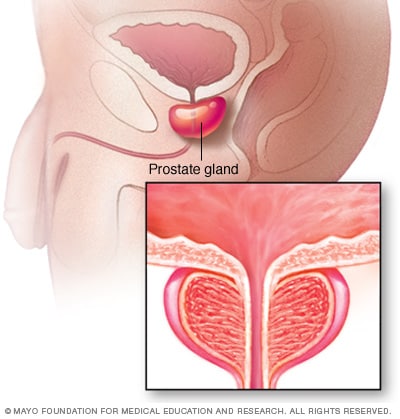
前列腺
前列腺位于膀胱正下方。包裹着尿道(从膀胱排出尿液的管道)的顶部。前列腺的主要功能是分泌滋养和输送精子所需的液体,称为精液。前列腺是男性生殖系统的一部分。
钬激光前列腺手术是一种针对前列腺肿大的微创治疗。也称为钬激光前列腺剜除术(简称 HoLEP),使用激光切除阻碍尿液流经前列腺的组织。然后使用单独的仪器将前列腺组织切成易于切除的碎片。
HoLEP 与开放式前列腺手术相似,但不需要切口。HoLEP 切除可能阻塞尿液的前列腺的整个部分。其是治疗严重前列腺肿大的可选方案。
这种治疗手段提供了前列腺肿大(又称 BPH,即良性前列腺增生)的持久解决方案。HoLEP 还可保留切除的组织,以便在实验室检查是否存在其他医疗状况,包括前列腺癌。
如同其他类型的前列腺激光手术,与传统的前列腺手术相比,HoLEP 可以加快患者康复和症状缓解的速度。极少数情况下,对于泌尿系统症状,可能需要再次采用 HoLEP 进行治疗。
阅读更多关于良性前列腺增生(BPH)和前列腺激光手术的信息。
目的
Holmium laser prostate surgery is done to treat benign prostatic hyperplasia, also called BPH. The surgery also is referred to as HoLEP. HoLEP often is used to improve urinary symptoms of BPH, such as:
- Feeling the need to urinate often.
- Difficulty urinating fully.
- Slow urine stream.
- Urinary tract infections, also called UTIs.
- Urinating often at night.
Your healthcare professional may recommend this treatment if you have an enlarged prostate and you:
- Are not able to completely empty your bladder.
- Have bladder stones.
- Have kidney failure.
- Have blood in your urine that doesn't get better with treatment.
- Get UTIs often.
- Have taken medicines for BPH but didn't get better.
- Have certain health conditions or take medicines that make traditional prostate surgery risky.
- Are at high risk of bleeding.
风险
Although holmium laser prostate surgery is minimally invasive, complications can happen. Some possible risks of treatment include:
- Bleeding, although the risk is lower than with traditional prostate surgery.
- Trouble urinating right after the procedure, which usually gets better with time.
- Leaking urine or loss of bladder control.
- Infection, including UTIs.
- Retrograde ejaculation, which happens when semen flows backward into the bladder during ejaculation.
- Narrowing of the tube that carries urine out of the body, called urethral stricture.
如何进行准备
In the weeks leading up to your holmium laser prostate surgery, your healthcare professional will likely:
- Ask about your health history and current medicines. Your healthcare professional may recommend that you stop taking certain medicines, such as blood thinners. This can help reduce the risk of bleeding during surgery. Talk to your healthcare team about the medicines you take.
- Do a physical exam. This may include a rectal exam to feel the prostate. A rectal exam helps your healthcare professional understand the size and shape of your prostate.
- Order tests or imaging. You may need some tests before your procedure, such as blood tests, urine tests or other tests to check your bladder. Imaging tests, such as magnetic resonance imaging (MRI), computerized tomography (CT) or ultrasound may be used. Results of these tests help your healthcare professional better understand the size, shape and characteristics of your prostate.
- Talk about anesthesia options. Your healthcare professional also may discuss your options for anesthesia, such as general anesthesia or spinal anesthesia.
可能出现的情况
Holmium laser prostate surgery may require an overnight hospital stay. Even if you go home the same day, it's important to arrange for a ride. You won't be able to drive yourself home.
Before the procedure
You may be asked not to eat or drink anything for several hours before your procedure. A member of your care team will give you either general anesthesia or spinal anesthesia, depending on what your healthcare professional recommends.
With general anesthesia, you are in a sleeplike state. You won't see, feel or hear anything during the procedure. With spinal anesthesia, you will have no feeling in the lower part of your body. You may be partly awake, or you may have medicines to make you sleepy.
During the procedure
During the procedure, a thin tube with a light and camera is inserted through the tip of the penis into the urethra. This device is called a rectoscope. The holmium laser is then passed through the rectoscope. Heat from the laser cuts away extra prostate tissue that's blocking urine flow. The removed tissue falls into your bladder.
Then a special tool breaks up the tissues into smaller pieces, which are suctioned out of the bladder. If needed, a piece of tissue is sent to a lab and tested for other conditions, such as prostate cancer.
After the procedure
You might go home after the procedure. Or you may need to stay in the hospital overnight. A catheter placed in your bladder drains your urine. Your healthcare professional may flush fluid through the catheter to remove any blood. Usually, the catheter is taken out a day or two after your procedure.
You may notice urinary symptoms after HoLEP, such as:
- Mild pain or burning during urination.
- Blood in the urine.
- Trouble controlling your urine, such as leaking.
Typically, these symptoms are part of the healing process and get better as you recover.
Talk to your healthcare professional about any symptoms that bother you, get worse or don't get better with time. If you have lightheadedness, fever, chills or bleeding thick enough to block urine flow, get medical help right away.
结果
The results of holmium laser prostate surgery are similar to traditional prostate surgery in improving symptoms of benign prostatic hyperplasia, also called BPH. In fact, some research shows that HoLEP is better than traditional prostate surgery in improving BPH symptoms.
Compared with people who have traditional prostate surgery, people who have HoLEP may:
- Spend less time at the hospital.
- Have a catheter removed sooner.
- Have fewer bleeding complications after the procedure.
- Have faster symptom improvement.
Some BPH symptoms may improve soon after HoLEP, while other symptoms may improve in a few weeks or months. Sometimes a second HoLEP procedure is needed, but this is rare. See your healthcare professional if your urinary symptoms don't get better.
临床试验
探索 Mayo Clinic 的研究 测试新的治疗、干预与检查方法,旨在预防、检测、治疗或控制这种疾病。
Dec. 16, 2025