Overview
Cardiopulmonary resuscitation (CPR) is an emergency treatment that's done when someone's breathing or heartbeat has stopped. For example, when someone has sudden cardiac arrest or nearly drowns. CPR can help save a life.
The American Heart Association recommends starting CPR by pushing hard and fast on the chest. The pushes are called compressions.
Here's general CPR advice from the American Heart Association. Specific details on how to do CPR can be found under the treatment section in this article.
- Not trained. If you're not trained in CPR or don't want to put your mouth on the person's mouth or nose, then do hands-only CPR. This means push hard and fast in the center of the chest 100 to 120 times a minute. Do this until medical help gets to you. You don't need to place your mouth on the person's mouth or nose and give rescue breaths.
- Trained but out of practice. If you are trained in CPR but are not sure of your skills, do hands-only CPR. Push hard and fast in the center of the chest 100 to 120 times a minute.
- Trained and ready to go. If you're well trained and confident in your CPR ability, check to see if there is a pulse and breathing. If there is no pulse or breathing within 10 seconds, start compressions. Push hard and fast on the center of the chest 30 times. Then give two rescue breaths. Keep doing this pattern of 30 chest compressions to two rescue breaths until medical help arrives.
The above information applies to situations in which adults, children and infants need CPR. The information does not apply to newborns. Newborns are babies up to 4 weeks old.
CPR can keep oxygen-rich blood flowing to the brain and other organs until medical help can get the heart beating again. When the heart stops, the body stops getting the oxygen it needs. This can cause brain damage in only a few minutes.
When to seek emergency help
If you are not trained in CPR but can get to a phone right away, call 911 or your local emergency number first. Then start CPR. The dispatcher can tell you how to do CPR until help gets there. To learn CPR the right way, take a first aid course that is accredited. The course should teach you how to do CPR and how to use an automated external defibrillator (AED).
If you're afraid to do CPR or are not sure how to do CPR correctly, know that it's always better to try than to do nothing at all. The difference between doing something and doing nothing could be someone's life.
Treatment
Before starting CPR, check:
- Is the environment safe for the person?
- Is the person awake, alert and aware of the surroundings? This is called conscious.
- If the person is not conscious, tap or shake the person's shoulder and ask loudly, "Are you OK?"
- If the person doesn't react and someone else is with you who can help, have one person call 911 or the local emergency number and get an AED if one is nearby. Have the other person begin CPR.
- If you are alone and have a phone with you, call 911 or your local emergency number before you start CPR. If your phone has a speaker mode, turn it on. If you are close to an AED, get it.
- Turn on the AED machine. It tells you what to do. The machine comes with sticky pads. Place them on the bare skin of the person's chest. Give the person one shock if the machine tells you to. Then start or restart CPR.
Remember to spell C-A-B
The American Heart Association uses the letters C-A-B to help people remember the order to perform the steps of CPR.
- C: compressions.
- A: airway.
- B: breathing.
Compressions for an adult who needs CPR
Compressions are a lifesaving activity and the most important step in CPR. To do chest compressions, you push hard and fast in a specific way on the center of a person's chest.
Follow these steps:
- Put the person on their back on a firm surface.
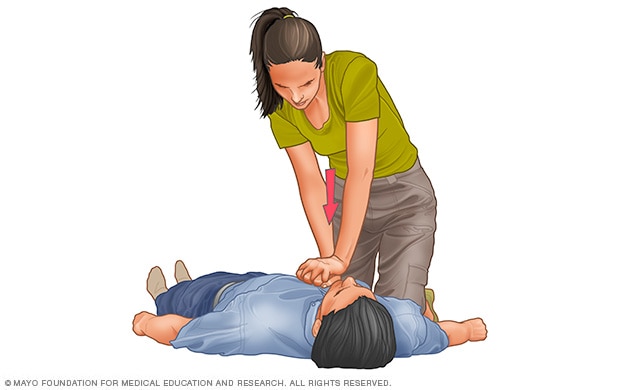
- Place the lower palm of your hand on the middle of the person's chest. Your hand should be on the lower half to lower third part of the breastbone. This would be slightly lower than a horizonal line drawn from nipple to nipple.
- Place your other hand on top of your first hand. Keep your elbows straight. Place your shoulders directly above your hands.
- Push straight down on the chest at least 2 inches (5 centimeters) but no more than 2.4 inches (6 centimeters). Use your entire body weight, not just your arms, when doing this.
- Push hard and fast in the center of the chest. You want to do 100 to 120 pushes a minute. The American Heart Association suggests doing the pushes to the beat of the song "Stayin' Alive" or another song that has 100 to120 beats a minute. Let the chest spring back after each push.
If you are not trained in CPR, keep doing the chest compressions until the person moves or reacts or until emergency medical help takes over. If you've had CPR training and are confident in your skills, you should do compressions and rescue breaths when possible.
Airway: Open the adult's airway
If you're trained in CPR and sure about your skills, the American Heart Association encourages you to do compressions and rescue breaths when possible.
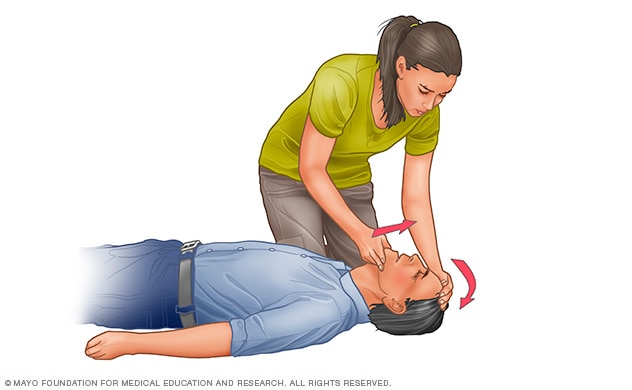
After the first 30 chest compressions, follow these steps to open the person's airway. This is called the head-tilt, chin-lift maneuver. Do not do the head-tilt, chin-life maneuver if there is a possible neck injury.
- Put your palm on the person's forehead.
- Gently tilt the person's head back.
- With the other hand, gently lift the person's chin forward to open the airway.
Chest compressions
Chest compressions are the most important step in CPR. To do chest compressions, place the lower palm of your hand over the middle of the person's chest. Then place your other hand on top of your first one. Keep your elbows straight. Your shoulders should be directly above your hands. Push straight down on the chest at least 2 inches (5 centimeters). Do not push down more than 2.4 inches (6 centimeters). Push hard and fast, 100 to 120 pushes a minute. If you aren't trained in CPR, keep doing chest compressions until the person reacts or moves or until emergency medical help takes over. If you are trained in CPR and confident in your skills, start rescue breathing.
Open the airway
If you're trained in CPR and confident in your skills, prepare for rescue breaths. After you do 30 chest compressions, open the person's airway using the head-tilt, chin-lift maneuver. Do not do this is if there is a possible neck injury. Put your palm on the person's forehead. Then, gently tilt the person's head back. With your other hand, gently lift the person's chin forward to open the airway.
Breathing for the adult
If you are trained in CPR, do rescue breathing after opening the airway using the head-tilt, chin-lift maneuver. Rescue breathing can be mouth-to-mouth breathing or mouth-to-nose breathing if the mouth area is hurt or can't be opened. The American Heart Association recommends that trained professionals do rescue breathing using a bag-mask device with a high-efficiency particulate air (HEPA) filter.
Follow these steps to do rescue breathing, after opening the airway.
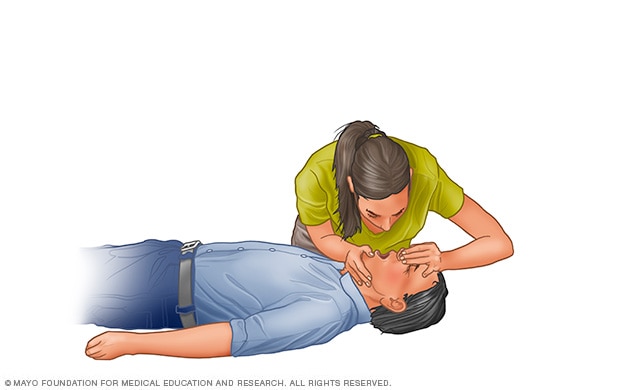
- Pinch the person's nose openings closed, then place your mouth over the person's mouth so no air can get out. This creates a seal for mouth-to-mouth breathing.
- Prepare to give two rescue breaths. Give the first rescue breath for one second and look to see whether the chest rises.
- If the chest rises, give a second breath.
- If the chest doesn't rise, open the airway again. Then do rescue breathing again. If this second breath still doesn't work, start chest compressions again right away. Do 30 chest compressions followed by two rescue breaths. Repeat this pattern of 30 compressions to two rescue breaths as needed to help keep blood moving through the body. You don't need to give more than two breaths every 30 compressions. Be careful not to give too many breaths or to breathe with too much force.
- As soon as you get an AED, turn it on and follow its directions. The machine tells you when to give a shock. Typically, you give one shock, then keep doing chest compressions for about two more minutes. Then the machine checks the heartbeat again and tells you whether to give a second shock. If you don't know how to use an AED, a 911 operator or another emergency medical person may be able to tell you how to use the machine. If you don't have an AED, go to step 6.
- Continue chest compressions until there are signs of movement or emergency medical help takes over.
Rescue breathing
If you're trained in CPR, start rescue breathing after opening the airway using the head-tilt, chin-lift maneuver. Pinch the person's nostrils shut, then cover the person's mouth with yours. This makes a seal for mouth-to-mouth breathing. Give the first rescue breath for one second. Watch to see whether the chest rises. If it rises, give the second breath. If the chest doesn't rise, open the airway again and give the breaths again. Then continue chest compressions. Do 30 pushes to every two rescue breaths. Be careful not to give too many breaths or to breathe with too much force.
How to do CPR on a child
The process for giving CPR to a child age 1 through puberty is essentially the same as that for an adult — follow the C-A-B steps outlined above. The American Heart Association says you should not wait to start CPR on a child. The organization offers this advice on how to do CPR on a child:
Compressions for a child who needs CPR
If you are alone and didn't see the child suddenly lose consciousness, start chest compressions and continue for about two minutes. After two minutes, quickly call 911 or your local emergency number and get an AED if one is nearby.
If you're alone and you did see the child collapse, call 911 or your local emergency number first. Then get an AED, if one is nearby. Then start CPR. If another person is with you, have that person call for help and get the AED while you start CPR.
- Place the child on their back on a firm surface when possible.
- Kneel next to the child.
- Place two hands on the lower half of the child's breastbone. If the child is very small, use one or two hands.
- Using the lower palm of one or both of your hands, press straight down on the chest about 2 inches (5 centimeters). Push hard and fast 100 to 120 times a minute.
- If you are not trained in CPR, keep doing chest compressions until the child moves or until emergency medical help takes over. You do not need to give rescue breaths.
- If you are trained in CPR, the American Heart Association says you should do both chest compressions and rescue breaths for children.
Airway: Open the child's airway
If you're trained in CPR and you've done 30 chest compressions, open the child's airway using these head-tilt, chin-lift maneuver instructions.
- Place your palm on the child's forehead.
- Gently tilt the child's head back.
- With the other hand, gently lift the child's chin forward to open the airway.
Breathing: Breathe for the child
Follow these steps for mouth-to-mouth breathing for a child.
- After using the head-tilt, chin-lift maneuver to open the airway, pinch the child's nostrils shut. Cover the child's mouth with yours. This makes a seal.
- Breathe into the child's mouth for one second. Watch to see whether the chest rises. If it rises, give a second breath.
- If the chest doesn't rise after the first breath, open the airway again. Then give a second breath. Try not to give too many breaths or to breathe with too much force.
- After giving two breaths, start compressions right away. Do this even if the child doesn't breathe after you give the second rescue breath.
- If there are two people available to do CPR on the child, change rescuers every two minutes, or sooner if a rescuer is tired. Give two breaths every 15 compressions.
- As soon as an AED is available, follow the machine's directions. Use pediatric pads for infants and children under age 8. If the machine doesn't have pediatric pads, it's OK to use adult pads. Give one shock if the machine tells you to do so, then start compressions again right away. Do not give a second shock unless the AED tells you to do so. If you don't know how to use an AED, a 911 operator or other emergency medical person may be able to give you directions.
Continue until the child moves or help arrives.
To do CPR on a baby 4 weeks old or older
Sudden cardiac arrest in babies is usually due to a lack of oxygen, such as from choking. If you know that the baby's airway is blocked, give first aid for choking. If you don't know why the baby isn't breathing, start CPR.
First, touch the baby and watch for a reaction, such as movement. Don't shake the baby.
If the baby doesn't react, call 911 or your local emergency number first. Then start CPR right away.
Follow the compressions, airway and breathing (C-A-B) method for a baby under age 1. Do not follow this method for babies up to 4 weeks old, who are called newborns.
If you saw the baby collapse, start CPR right away. Use an AED as soon as one is available. If you're with another person who can help, have that person call for help right away and get the AED. You stay with the baby and do CPR.
Compressions for a baby who needs CPR
- Place the baby on their back on a firm, flat surface. For example, a table or the floor.
- Place two fingers in the center of the chest, a little below the middle of the breastbone.
- Gently press down on the baby's chest using your two fingers. Push down about 1.5 inches (4 centimeters).
- Do 100 to 120 pushes, called compressions, a minute. It may help to count out loud as you do them.
Airway: Open the baby's airway
After the first 30 chest compressions, follow these steps to open the baby's airway. This is called the head-tilt, chin-lift maneuver. Do not do this maneuver if the baby's spine or head might be hurt.
- Put your palm on the baby's forehead.
- Gently tilt the baby's head back.
- With the other hand, gently lift the baby's chin forward to open the airway.
Breathing: Breathe for the baby
- Cover the baby's mouth and nose with your mouth.
- Give a gentle puff of air to the baby instead of a forceful blow of air. Each rescue breath should last about one second.
- After the first breath, watch to see whether the baby's chest rises. If it does, give a second rescue breath.
- If the chest does not rise after the first rescue breath, open the baby's airway again. Then give another breath.
- If the baby's chest still doesn't rise, do chest compressions again right away.
- Give the baby two breaths after every 30 chest compressions.
- Keep doing CPR until the baby reacts or moves or until medical help arrives.
