Descripción general
Metástasis cerebrales
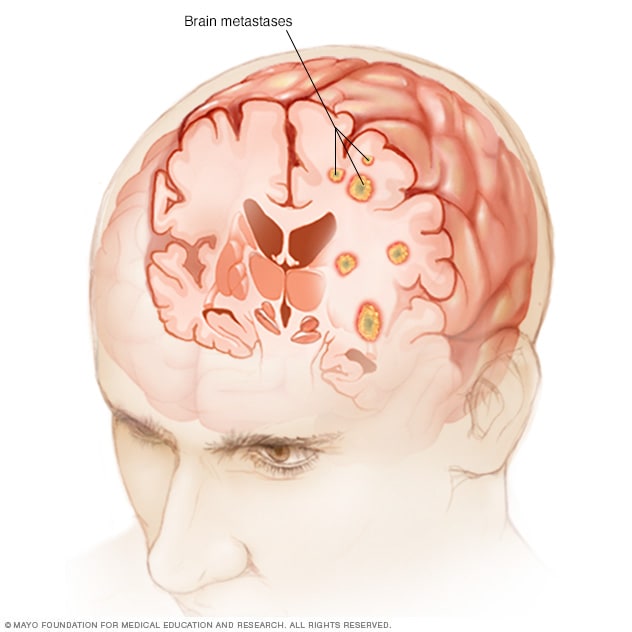
Metástasis cerebrales
La metástasis cerebral ocurre cuando el cáncer se origina en otra parte del cuerpo y se propaga (hace metástasis) al cerebro.
Las metástasis cerebrales se producen cuando las células cancerosas se diseminan de su lugar original al cerebro. Cualquier cáncer puede diseminarse al cerebro. Pero los tipos más comunes que se diseminan son los de pulmón, mama, colon, riñón y melanoma.
Las metástasis cerebrales pueden formar uno o más tumores en el cerebro. A medida que crecen, ejercen presión sobre el tejido cerebral circundante. Esto puede causar síntomas, como dolores de cabeza, cambios de personalidad, confusión, convulsiones, cambios en la visión, dificultad para hablar, entumecimiento, debilidad o pérdida del equilibrio.
El tratamiento para las personas cuyo cáncer se diseminó al cerebro puede incluir cirugía, radioterapia, inmunoterapia, terapia dirigida o quimioterapia. Pueden utilizarse otros tratamientos para disminuir el dolor y los síntomas causados por el cáncer.
Productos y servicios
Types
Brain metastases, also called brain mets or secondary brain tumors, occur when cancer spreads from another part of the body to the brain.
Brain metastases are classified based on where cancer cells spread within the central nervous system. The two main patterns of spread are parenchymal metastases and leptomeningeal metastases. These patterns affect different parts of the brain and spinal cord and may require different approaches to diagnosis and treatment.
Parenchymal metastases
Parenchymal metastases occur when cancer spreads from another part of the body into the brain tissue itself. These form discrete tumors within the brain. A person may have one tumor or several tumors located in different areas.
Parenchymal metastases are the most common form of brain metastasis.
Leptomeningeal metastases, also called leptomeningeal disease
Leptomeningeal metastases, also called leptomeningeal disease (LMD) or neoplastic meningitis, occur when cancer cells spread to the thin layers of tissue and the cerebrospinal fluid that surround the brain and spinal cord.
Instead of forming a single mass, cancer cells spread along the surface of the brain and spinal cord and within the fluid that circulates around them. This pattern of spread can affect multiple areas of the nervous system.
Síntomas
Los síntomas causados por la metástasis pueden variar. Dependen de la ubicación, el tamaño y la rapidez con la que crecen.
Los síntomas de las metástasis cerebrales incluyen:
- Dolores de cabeza, a veces con vómitos o náuseas.
- Cambios mentales, como el aumento de los problemas de memoria.
- Convulsiones.
- Entumecimiento o debilidad en un lado del cuerpo.
- Cambios en la visión.
- Dificultad para hablar o entender el idioma.
- Pérdida de equilibrio.
Symptoms of parenchymal metastases
Parenchymal metastases form tumors within the brain tissue. Symptoms usually relate to the specific area of the brain where the tumor is located.
Symptoms may include:
- Headache, which may become more frequent or more severe over time and may occur with nausea or vomiting.
- Changes in thinking or behavior, such as confusion, difficulty concentrating or increasing memory issues.
- Seizures, even in people who have never had seizures before.
- Weakness or numbness, often affecting one side of the body.
- Vision changes, such as blurred vision, double vision or loss of part of the visual field.
- Difficulty speaking or understanding language.
- Balance or coordination issues.
Symptoms of leptomeningeal metastases
Leptomeningeal metastases involve cancer cells spreading within the fluid and thin tissues that surround the brain and spinal cord. Because this spread can affect multiple areas of the nervous system at the same time, symptoms may be more widespread.
Symptoms may include:
- Headaches.
- Nausea and vomiting.
- Vision changes, such as blurred vision or double vision.
- Facial weakness or numbness.
- Hearing loss.
- Difficulty swallowing.
- Confusion or changes in thinking or behavior.
- Weakness or loss of feeling in the arms or legs.
- Back or neck pain that may spread into the arms or legs.
- Difficulty with bowel or bladder control.
- Changes in alertness.
- Seizures.
Cuándo debes consultar a un médico
Pide una cita con el profesional de atención médica si presentas signos y síntomas persistentes que te preocupan. Si recibiste tratamiento contra el cáncer, informa al médico tus antecedentes médicos.
Causas
Las metástasis cerebrales se producen cuando las células cancerosas se desprenden de su lugar original. Las células pueden viajar a través del torrente sanguíneo o del sistema linfático y diseminarse al cerebro.
El cáncer que se disemina desde su ubicación original se conoce con el nombre del cáncer primario. Por ejemplo, el cáncer que se ha extendido del pecho al cerebro se llama cáncer de mama metastásico, no cáncer de cerebro.
Factores de riesgo
Cualquier tipo de cáncer puede diseminarse al cerebro. Algunos de los tipos de cáncer con mayor probabilidad de causar metástasis son los siguientes:
- Cáncer de pulmón.
- Cáncer de mama.
- Cáncer de colon.
- Cáncer de riñón.
- Melanoma.
Nov. 20, 2024