
Deciding whether you need a prostate check isn't always an easy decision.
Prostate cancer screening can help find
early, when treatment is most effective. This seems like a good reason to get a prostate check. But prostate cancer screening isn't perfect. It can lead to more tests, and some tests are invasive. Sometimes you have these other tests and they don't find cancer. Sometimes the tests find a cancer that grows slowly and might never actually hurt you. This might lead to cancer treatments that may not have been necessary.Ultimately, whether to have prostate cancer screening is a decision you make with your healthcare professional. A health professional who understands your health history can help you understand what's best for you based on your risk factors and your personal preferences. Healthcare professionals often call this "shared decision-making."
If you're wondering whether you should get your prostate checked, here's some information to help you talk about it with your healthcare professional.
When should I start prostate cancer screening?
Most men who decide to have prostate cancer screening should start around age 50. When to start may depend on whether you have risk factors for prostate cancer.
- Start at age 50 if you: Don't have any risk factors for prostate cancer.
- Start at 40 to 45 if you: Have risk factors for prostate cancer, such as being Black, having a family history of prostate cancer, and having a personal or family history of DNA changes that increase the risk of prostate cancer, such as BRCA1 and BRCA2.
Prostate cancer screening involves tests that check for signs of cancer in the prostate in people who don't have symptoms. The prostate is a small gland that helps make semen. It's found just below the bladder. The prostate is part of the male reproductive system.

Prostate gland
The prostate gland sits just below the bladder. It surrounds the top part of the tube that drains urine from the bladder, called the urethra. The prostate's main job is to make some of the fluid that feeds and carries sperm, called seminal fluid. The prostate is part of the male reproductive system.
How often should I get my prostate checked?
Prostate cancer screening is usually repeated every one or two years.
Most healthcare professionals recommend that men stop screening at around age 70 or if they get other serious medical conditions that limit their life expectancy. However, some men continue with screening beyond age 70 depending on their overall health.
Does a urologist do prostate checks?
Urologists can do prostate checks. But you don't need to make an appointment with a urologist to have prostate cancer screening. The healthcare professional you usually see, such as your primary health professional, is typically the one who does prostate cancer screening. If anything concerning is found, that person might recommend that you see a urologist.
How do healthcare professionals check for prostate cancer?
Prostate cancer screening often involves a blood test. Sometimes it also includes a prostate exam.
Tests used for prostate cancer screening include:
- PSA test. The uses a sample of blood to look for a protein made by prostate cells. Typically, there is a small amount of PSA in the bloodstream. If a higher than usual amount is found, it may indicate prostate cancer. However, a high PSA level does not always mean that you have prostate cancer, as other common conditions can cause it. Also, PSA level often goes up with age.
- DRE. During a digital rectal exam (DRE), a healthcare professional inserts a gloved, lubricated finger into the rectum. The prostate is right by the rectum. The health professional feels the prostate for anything concerning in the texture, shape or size of the gland.
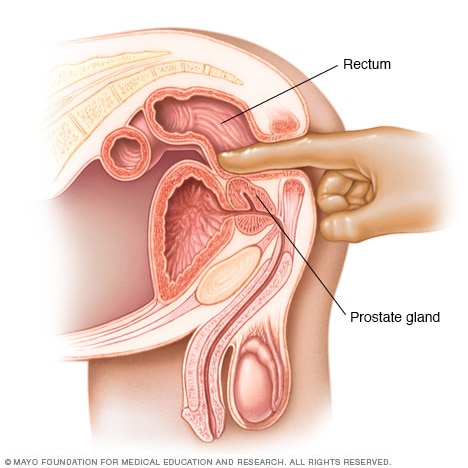
Digital rectal exam
During a digital rectal exam, a healthcare professional inserts a gloved, lubricated finger into the rectum. The health professional feels the prostate gland for anything concerning in the texture, shape or size of the gland.
What happens if the PSA level is high?
If your PSA level is high, your healthcare professional might test it again in a few weeks or months. Many things can cause an elevated PSA level, including getting older, sexual intercourse, ejaculation, exercise, certain medicines, and some health conditions, such as prostate infections and an enlarged prostate.
Can I check for prostate cancer at home?
Kits that let you test your PSA level at home are sold online. But these aren't recommended. PSA test results aren't easy to understand because there isn't a certain PSA level that says you have cancer or you don't. For this reason, it's a good idea to get your prostate checked by a healthcare professional who understands your overall health and can help you understand what your results mean.
Can other tests find prostate cancer?
Other tests aren't used for prostate cancer screening. But sometimes other tests can detect it when looking for something else. For example, a healthcare professional might see something that looks like prostate cancer during cystoscopy or in the results of an imaging test, such as ultrasound, CT, MRI or positron emission tomography (PET). Some people wonder whether a colonoscopy might show prostate cancer, but it typically doesn't.
Other tests might be used to look for prostate cancer if the PSA level is high and the healthcare team wants to get more information before deciding whether to do a biopsy. These other tests might include urine tests, bloodwork and prostate MRI.
Why should I get prostate cancer screening?
Benefits of prostate cancer screening include:
- Screening helps detect prostate cancer early. Cancer is easier to treat and is more likely to be cured if it's diagnosed in the early stages of the disease.
- Screening provides a certain amount of information about your risk. Screening provides more information. Some people want to know their PSA level, even if prostate cancer screening has limitations. If you want to know your PSA level, rather than not know, you might choose screening.
- It may lower the risk of dying of prostate cancer. There is some evidence that screening can lower the number of prostate cancer deaths. But results from studies have been mixed.
What are the risks of prostate cancer screening?
Limitations and potential harms to prostate cancer screening include:
- Screening tests aren't foolproof. It's possible for PSA levels to be elevated when cancer isn't present. It's also possible for PSA levels to not be elevated when cancer is present.
- Sometimes screening finds a cancer that isn't likely to hurt you. Not all prostate cancers need treatment. Some prostate cancers are slow growing and never spread beyond the prostate gland. Others grow faster, and treatment can stop them from spreading and becoming life-threatening. Healthcare professionals may not know for sure whether a cancer found during screening needs treatment right away.
- Treatment for prostate cancer may have risks and side effects. These include urinary incontinence, erectile dysfunction or bowel dysfunction.
- The benefits of the test may not outweigh the risks. Prostate cancer screening has lowered the number of prostate cancer deaths, but the number may not be big enough to justify the chances of harm to the person undergoing the testing.
Talk with your healthcare team about the pros and cons of prostate cancer screening. Your care team can help you understand what's best for you. Then you can make a decision about if or when to have prostate cancer screening.
ART-20048087