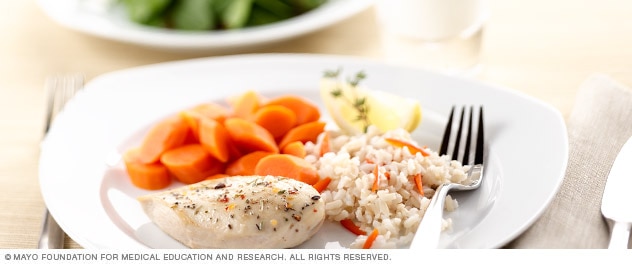
Trying to lose weight? Remember the size of the portions you eat.
Visual cues for portion control
Research has shown that people almost always eat more food when offered larger portions. So portion control is important when you're trying to lose weight and keep it off.
A portion is the amount of food you put on your plate. A serving is an exact amount of food. To better manage what you're eating, you could carry around measuring cups and spoons. Or instead, you could use everyday objects as reminders, also called cues, of correct serving sizes, as recommended by the Mayo Clinic Diet.
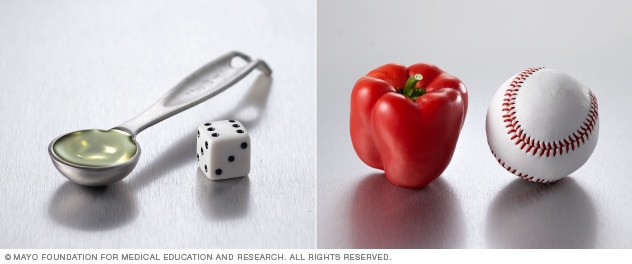
Many foods match up to everyday objects. For example, a medium pepper is about the size of a baseball and equals one vegetable serving. While not all foods match visual cues, this method can help you become better at gauging serving sizes and practicing portion control.
Fruits
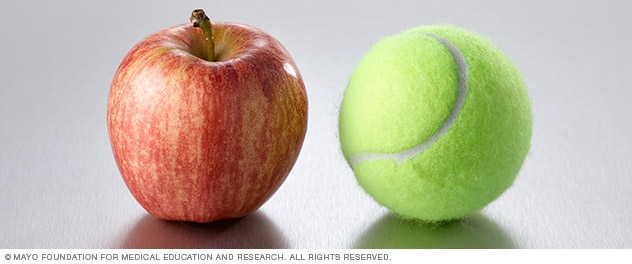
One fruit serving is about the size of a tennis ball. For example, a small apple equals one serving, or about 60 calories. The same is true for a medium orange.
Vegetables
One vegetable serving is about the size of a baseball. Half a cup of cooked carrots equals one serving, or about 25 calories. The same is true for a medium tomato or bell pepper.

Carbohydrates
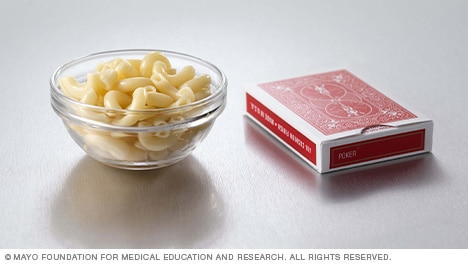
One carbohydrate serving is about the size of a deck of cards. Half a cup of whole-grain cooked pasta equals one serving, or about 70 calories. If you don't eat pasta, think of a slice of whole-grain bread instead.
Proteins
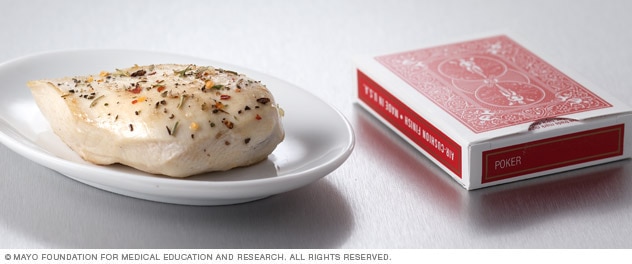
One protein serving is no bigger than a deck of cards. A piece of cooked skinless chicken (2 to 2 1/2 ounces) equals one serving, or about 110 calories. This is the same as a serving of a 3-ounce vegetarian burger.
Fats
One fat serving is about the size of a pair of dice. For example, 2 teaspoons of regular mayonnaise equal one fat serving, or about 45 calories. And 1 tablespoon of trans fat-free light margarine counts as a serving, as does 1 teaspoon of butter.

Putting it all together
It may take practice to become a better judge of serving sizes and portions, especially as you put entire meals together. As you can see, some foods, especially vegetables and fruits, have fairly few calories in large serving sizes and portions. And the more you practice, the more control you'll have over how many calories you eat. That's key to weight loss.