Enjoying activities outside or working a job that takes you outdoors can mean hours under the sun. Over months and years, those hours add up, and the time in the sun may damage your skin. Read on to learn about skin conditions that can be caused by too much sunshine.
Uneven pigmentation
To protect itself from the damaging effects of the sun, skin makes more brown pigment, called melanin. That extra melanin is what creates a suntan. But sometimes skin doesn't make melanin evenly. As a result, the skin's coloring, called pigmentation, looks patchy. The sun also can cause small blood vessels to stretch, giving skin a blotchy look.
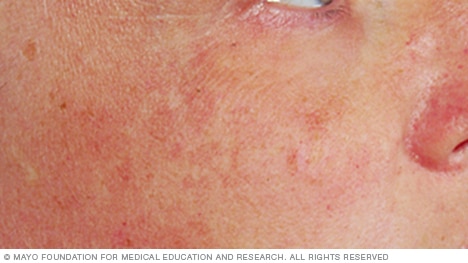
Damage to brown or black skin
Melanin is the brown pigment in the top layer of skin that gives skin its color. Melanin protects the deeper layers of skin from sun damage. The more melanin in the skin, the darker the skin looks, and the more protection it has against sun damage.
People with brown or black skin have more natural protection from the sun than do people with white skin. But darker skin still can be damaged by the sun, resulting in wrinkles and areas of uneven color.

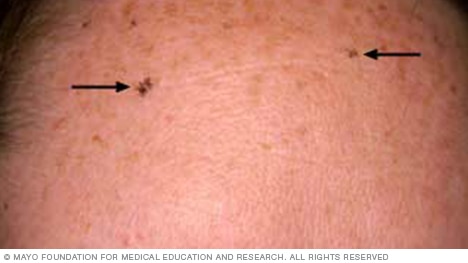
Solar lentigines on the forehead
Solar lentigines (len-TIJ-ih-neez) are flat spots that are darker than the skin around them. They are usually tan, brown or dark brown, depending on skin color. Typically, they are darker than freckles. Solar lentigines usually have oval to round shapes with uneven edges. They can be different sizes. They tend to show up on areas most exposed to the sun, such as the head, face, hands, arms and upper body. Also called liver spots, they are common in older adults. But children with white skin who spend a lot of time in the sun also may develop solar lentigines.
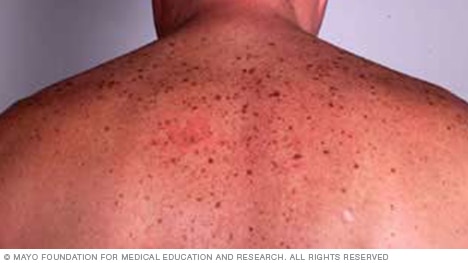
Solar lentigines on the back
With age and with more time outdoors, people tend to develop more solar lentigines. Sometimes solar lentigines appear in large numbers, as seen on the upper back in the photo below. Solar lentigines are similar to freckles. But unlike freckles, solar lentigines don't tend to fade during colder months.
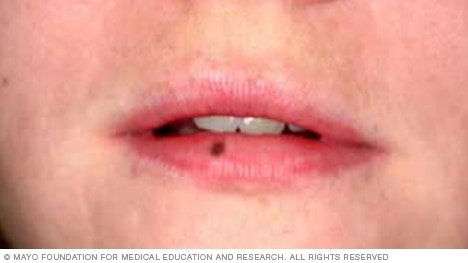
Labial lentigo
A labial lentigo is a harmless, small, flat, brown spot on the lip. It's also called labial melanotic macule. It can appear after spending time in the sun. In most cases, labial lentigo forms on the lower lip.
Solar elastosis
The sun's ultraviolet radiation breaks down the connective tissue — collagen and elastin fibers — that lies in the deeper layer of the skin. Without that supportive connective tissue, the skin loses its elastic quality. This condition is called solar elastosis (e-las-TOE-sis). Skin affected by solar elastosis has deep wrinkles that don't disappear when stretched. The skin also may look yellow.
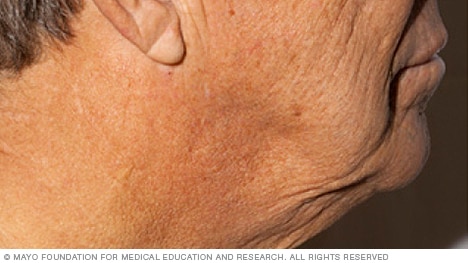
Melasma
Melasma (muh-LAZ-muh) is a darkening of skin on the face. It's sometimes called the mask of pregnancy. Dark patches usually appear on the forehead and cheeks. Melasma can get worse after time in the sun.
Melasma often affects:
- Black, Asian and Hispanic women.
- Women who use birth control pills or hormone therapy.
- Women in their second or third trimester of pregnancy.
Melasma might fade after the birth of a baby, during the winter months or when a woman stops taking birth control pills. But melasma also can last for years.

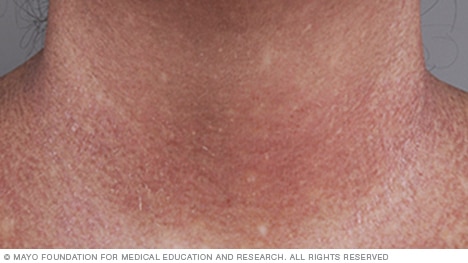
Poikiloderma
Poikiloderma (POI-kih-loe-DUR-muh) appears as areas of uneven coloring on the skin. It's most common on the areas of the neck and upper chest that are often exposed to sunlight. If those areas continue to be exposed to the sun, poikiloderma can get worse over time.
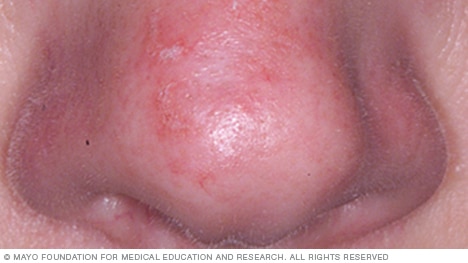
Actinic keratosis
Actinic keratosis (ak-TIN-ik ker-uh-TOE-sis) looks like a rough, scaly patch on the skin. The color may be from tan or red to brown, depending on skin color. Actinic keratosis also is called solar keratosis. It's commonly found on areas of the skin often exposed to sunlight in people who have white skin. Sometimes, actinic keratosis may develop into a type of skin cancer called squamous cell carcinoma. Because there's no way to tell if one of these patches will become cancer, all actinic keratoses need treatment. Make a medical appointment if you notice a patch on your skin that could be actinic keratosis.
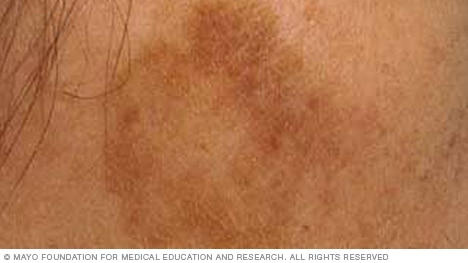
Lentigo maligna
Lentigo maligna is a type of growth that develops on areas often exposed to the sun over a long period of time, including the face, arms and legs. Lentigo maligna starts as a flat spot with an uneven shape that slowly gets bigger. When it first appears, a lentigo maligna usually is brown or brown-black. Later, it might develop red and white patches. Over time, the spot may turn into melanoma. Melanoma is a type of skin cancer that begins in the top layer of skin. It then moves to the layers of skin underneath.
See your health care professional if you notice:
- A new skin growth.
- Changes to a mole you already have, such as a change in size, shape or color.
- A mole that bleeds or becomes itchy or painful.
- Any skin changes that are out of the ordinary for you.
Take steps to protect your skin
You can protect your skin and minimize sun damage by taking the steps below when you're outdoors. Follow these tips even on cool, cloudy or hazy days. Be extra careful around water, snow, concrete and sand because they reflect the sun's rays. And keep in mind that sunlight is more intense at higher altitudes.
- Cover up. For the most protection from the sun, cover your skin when you're outdoors. Dark clothing with a tight weave offers more protection than light-colored clothing or clothing with a loose weave. Try outdoor gear designed for sun protection. Check the label for its ultraviolet protection factor (UPF). That tells how well a fabric blocks sunlight. The higher the UPF number, the more protection you get. Wear a wide-brimmed hat or use an umbrella to shade skin that can't be covered, along with wearing sunscreen.
- Use sunscreen often and generously. On uncovered skin, use a broad-spectrum sunscreen with a sun protection factor (SPF) of at least 30. Apply sunscreen generously. Reapply every two hours, or more often if you're swimming or sweating.
- Avoid being in the sun between 10 a.m. and 4 p.m. The sun's rays are strongest during these hours, so try to schedule outdoor activities for other times, if possible. If you have to be outside during the middle of the day, try to limit the time you're in the sun. Stay in the shade as much as you can.
