
Diagnosis
Moyamoya disease is usually diagnosed by a doctor who specializes in conditions of the brain, called a neurologist. The neurologist reviews your symptoms and your family and medical history. The neurologist also may perform a physical exam. Several tests are generally needed to diagnose moyamoya disease and any underlying conditions.
Tests may include:
- Magnetic resonance imaging. This imaging test also is known as an MRI. An MRI uses powerful magnets and radio waves to create detailed images of the brain. A healthcare professional may inject a dye into a blood vessel to view your arteries and veins and highlight blood circulation. This type of test is called a magnetic resonance angiogram.
Your neurologist may recommend a perfusion MRI. This type of imaging can measure the amount of blood passing through the vessels. It can show if there is a decrease in blood supply to the brain.
- Computerized tomography scan. Also known as a CT scan, this imaging test uses a series of X-rays to create a detailed image of your brain. A healthcare professional may inject a dye into a blood vessel to highlight blood flow in your arteries and veins. This is called a CT angiogram. This test can't diagnose early stages of moyamoya disease. But it may help find problems with blood vessels.
- Cerebral angiogram. In a cerebral angiogram, a healthcare professional inserts a long, thin tube called a catheter into a blood vessel in your groin. The healthcare professional then uses X-ray imaging to guide the catheter to your brain and injects dye through the catheter into the blood vessels of your brain. The dye conforms to the shape of the blood vessels to make them more visible under X-ray imaging.
- Positron emission tomography scan or single-photon emission computerized tomography. In these tests, you're injected with a small amount of a safe radioactive material. Positron emission tomography, also called PET, provides visual images of brain activity. Single-photon emission computerized tomography, called SPECT for short, measures blood flow to the brain.
- Electroencephalogram. An electroencephalogram also is called an EEG. It monitors the electrical activity in your brain using small metal disks, called electrodes, attached to your scalp. Children with moyamoya disease often have EEG results that are out of the typical range.
- Transcranial Doppler ultrasound. In surgical transcranial Doppler ultrasound, sound waves are used to obtain images of your head and sometimes your neck. Specialists may use this test to evaluate blood flow in blood vessels in your neck.
If necessary, your neurologist may order other tests to rule out other conditions.
Treatment
Healthcare professionals evaluate your condition and determine the treatment that is right for you. Treatment doesn't cure moyamoya disease. But treatment can help prevent strokes.
The goal of treatment is to reduce your symptoms and improve blood flow to the brain. Treatment also aims to lower your risk of complications. Complications include ischemic stroke caused by a lack of blood flow, bleeding in your brain and death.
The outlook for moyamoya disease, also called the prognosis, depends on several factors, including:
- How early the disease was diagnosed.
- How much damage has happened when you seek treatment.
- Whether or not you undergo treatment.
- Age.
Your treatment may include medicine, surgery and therapy.

Moyamoya treatment consultation at Mayo Clinic
Mayo Clinic healthcare professionals provide comprehensive treatment for people with moyamoya.
Medicine
Medicines may be prescribed to manage symptoms, to reduce the risk of a stroke or to aid in seizure control. Medicines may include:
- Blood thinners. Blood thinners are typically recommended if you've been diagnosed with moyamoya disease and you have mild or no symptoms. Your healthcare professional may recommend that you take aspirin or another blood thinner to prevent strokes.
- Calcium channel blockers. Also known as calcium antagonists, this type of medicine may help manage headaches. It also may help reduce symptoms related to transient ischemic attacks. Calcium channel blockers can help manage blood pressure, which can help prevent blood vessel damage in people with moyamoya disease.
- Anti-seizure medicines. These medicines could be helpful for those who have had seizures.
Surgery
Early surgical treatment can help slow progression of moyamoya disease. Your neurologist may recommend revascularization surgery if you develop symptoms or strokes. Surgery also may be recommended if tests show evidence of low blood flow to your brain.
In revascularization surgery, surgeons bypass blocked arteries. They do this by connecting blood vessels on the outside of the skull to the inside of the skull to help restore blood flow to your brain. This may include direct or indirect revascularization procedures. Or it may include a combination of both.
- Direct revascularization procedures. In direct revascularization surgery, surgeons stitch the scalp artery directly to a brain artery. This also is known as superficial temporal artery to middle cerebral artery bypass surgery. This procedure increases blood flow to your brain immediately.
Direct bypass surgery may be difficult to perform in children due to the size of the blood vessels. But it's the preferred option in adults. This intervention can be performed safely and effectively by an experienced surgical team that treats people with moyamoya disease daily.
- Indirect revascularization procedures. In indirect revascularization, the goal is to increase blood flow to the brain gradually. In adults being treated in high-volume surgical centers, indirect revascularization is almost always combined with direct revascularization.
Indirect revascularization procedures include encephaloduroarteriosynangiosis. This also is called EDAS. They include encephalomyosynangiosis, also called EMS. Or they include a combination of both.
In EDAS, a surgeon makes a small temporary opening on the scalp to expose the artery. Then the surgeon makes an opening in your skull directly beneath the artery. The surgeon lays the intact scalp artery onto the surface of your brain, which allows blood vessels from the artery to grow into your brain over time. The surgeon then replaces the bone and closes the opening in your skull.
In EMS, your surgeon separates a muscle in the temple region of your forehead and places it onto the surface of your brain through an opening in your skull. This helps restore blood flow.
Your surgeon may perform EMS with EDAS. In this procedure, your surgeon separates a muscle in the temple region of your forehead. The surgeon places it onto the surface of your brain after attaching the scalp artery to the surface of your brain. The muscle helps to hold the artery in place as blood vessels grow into your brain over time.
Possible surgery risks of revascularization procedures for moyamoya disease include changes in pressure in the blood vessels in the brain. This can cause headaches, bleeding and seizures. However, the benefits of surgery largely outweigh the risks.
Some people with moyamoya disease develop a bulge or ballooning of a blood vessel in the brain known as a brain aneurysm. If this happens, surgery may be necessary to prevent or treat a ruptured brain aneurysm.
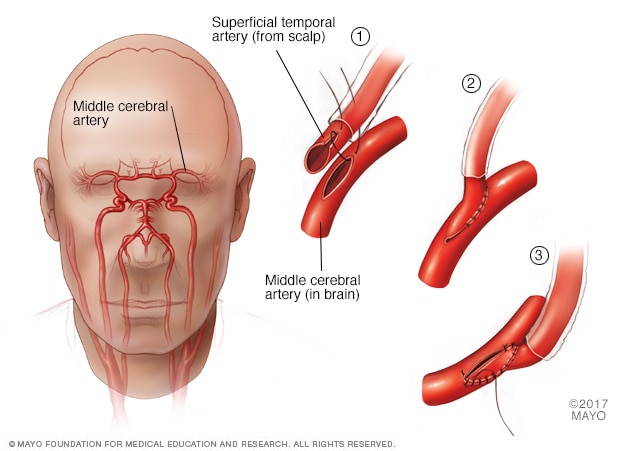
Direct revascularization procedure for moyamoya disease
In a direct revascularization procedure, your surgeon connects a scalp artery, known as a superficial temporal artery, directly to the middle brain artery, known as a middle cerebral artery. This increases blood flow to the brain.
Therapy
To address the physical and mental effects of a stroke on you or your child, your healthcare professional may recommend an evaluation by a psychiatrist or therapist. Without surgery, moyamoya disease can cause cognitive decline due to narrowing blood vessels. A psychiatrist may look for signs of problems with thinking and reasoning skills. The psychiatrist also may monitor you or your child for signs that those problems are worsening.
Cognitive behavioral therapy can help address emotional issues related to having moyamoya disease, such as how to cope with fears and uncertainties about future strokes.
Physical and occupational therapy can help regain any lost physical function caused by a stroke.
Preparing for your appointment
If you or your child has been diagnosed with moyamoya disease, you'll most likely be referred to a doctor who specializes in brain conditions, known as a neurologist.
Here's some information to help you get ready for your appointment.
What you can do
- Be aware of anything you need to do ahead of time. At the time you make the appointment, be sure to ask if there's anything you or your child needs to do in advance, such as restrict your diet.
- Write down symptoms you or your child has, including any that may not seem related to the reason for which you scheduled the appointment.
- Write down important personal information, including major stresses or recent life changes.
- Make a list of all medicines, vitamins or supplements you or your child is taking and the doses.
- Take a family member or friend along. Sometimes it can be hard to remember all the information provided during an appointment. Someone who goes with you may remember something that you missed or forgot.
- Write down questions to ask your healthcare team.
Your time with your healthcare team is limited, so preparing a list of questions can help you make the most of your time together. List your questions from most important to least important in case time runs out. For moyamoya disease, some basic questions to ask include:
- What is likely causing my or my child's symptoms or condition?
- What tests are necessary? Do they require any special preparation?
- What treatments are available, and which do you recommend?
- What side effects can be expected from treatment?
- Is surgery a possibility?
- Are you prescribing medicine? If so, is there a generic alternative?
- I have other medical problems. How can they be managed together?
- Will I or my child have any restrictions on physical activity?
- Are there brochures or other printed materials that I can take with me? What websites do you recommend?
What to expect from your doctor
Your healthcare professional is likely to ask a number of questions, such as:
- When did symptoms first begin?
- How often do the symptoms occur?
- Do certain activities trigger symptoms?
- Has anyone in your immediate family ever had moyamoya disease?